Wednesday, February 17, 2010

Photographs

This is my bear,which I brought to school for show and tell. Sher Li likes it and tried to snatch it in the train.


Sorry the photo is upside down,but... This is Sher Li in the MRT. She was trying hard to dodge my "evil camera" and the photo was ruined.


Looking attentively at the phone...


Guang Jun is trying to get in the picture,a direct opposite of Sher Li. He probably wants his face to be posted on the blog!


This is Sher Li,who is trying to shun the camera again. Haha,she still can't get out of my "evil grasp"...

Friday, February 12, 2010

Photography

1)Types of Photography

Black-and-white

All photography was originally monochrome, or black and white.. Even after color film was readily available, black-and-white photography continued to dominate for decades, due to its lower cost and its "classic" photographic look. It is important to note that some monochromatic pictures are not always pure blacks and whites, but also contain other hues depending on the process. The cyanotype process produces an image of blue and white for example. The albumen process, first used more than 150 years ago, produces brown tones.

Colour Photography

Colour photography is photography that uses media capable of representing colors which are produced chemically during thephotographic processing phase. It is contrasted with black-and-white photography, which uses media capable only of showing shades of gray. It does not include hand colored or Photochrome photographs either. Some examples of color photography include prints, color negatives, transparencies and slides, and roll and sheet films.

Full Spectrum Photography

Full-spectrum photography is a subset of full-spectrum imaging, defined currently among photography enthusiasts as imaging with consumer cameras the full, broad spectrum of a film or camera sensor bandwidth.

Digital Photography

Digital photography is a form of photography that uses digital technology to make images of subjects. Until the advent of such technology, photography used photographic film to create images which could be made visible by photographic processing. By contrast, digital photographs can be displayed, printed, stored, manipulated, transmitted, and archived using digital and computer techniques, without chemical processing.

Other Forms...

  • Architectural photography
  • Candid photography
  • Cloudscape photography
  • Documentary photography
  • Fashion photography
  • Fine art photography
  • Fire photography
  • Forensic photography
  • Food photography
  • Glamour photography
  • Head shot
  • Landscape art
  • Miksang (contemplative photography)
  • Nature photography
  • Photojournalism
  • Portrait photography
  • Sports photography
  • Still life photography
  • Stock photography
  • Street photography
  • Travel photography
  • Underwater photography
  • Vernacular photography
  • VR photography
  • War photography
  • Wedding photography
  • Wildlife photography

Equipment


Aperture
The aperture stop of a photographic lens can be adjusted to control the amount of light reaching the film or image sensor. In combination with variation of shutter speed, the aperture size will regulate the film's degree of exposure to light. Typically, a fast shutter speed will require a larger aperture to ensure sufficient light exposure, and a slow shutter speed will require a smaller aperture to avoid excessive exposure.

Focus


Rangefinder cameras allow the distance to objects to be measured by means of a coupled parallax unit on top of the camera, allowing the focus to be set with accuracy. Single-lens reflex cameras allow the photographer to determine the focus and composition visually using the objective lens and a moving mirror to project the image onto a ground glass or plastic micro-prism screen. Twin-lens reflex cameras use an objective lens and a focusing lens unit (usually identical to the objective lens.) in a parallel body for composition and focusing. View cameras use a ground glass screen which is removed and replaced by either a photographic plate or a reusable holder containing sheet film before exposure. Modern cameras often offer autofocus systems to focus the camera automatically by a variety of methods.
Shutter Speed

Shutter speed is ‘the amount of time that the shutter is open.

In film photography it was the length of time that the film was exposed to the scene you’re photographing and similarly in digital photography shutter speed is the length of time that your image sensor ’sees’ the scene you’re attempting to capture.

  • Shutter speed is measured in seconds – or in most cases fractions of seconds. The bigger the denominator the faster the speed (ie 1/1000 is much faster than 1/30).
  • In most cases you’ll probably be using shutter speeds of 1/60th of a second or faster. This is because anything slower than this is very difficult to use without getting camera shake. Camera shake is when your camera is moving while the shutter is open and results in blur in your photos.
  • If you’re using a slow shutter speed (anything slower than 1/60) you will need to either use a tripod or some some type of image stabilization (more and more cameras are coming with this built in).
  • Shutter speeds available to you on your camera will usually double (approximately) with each setting. As a result you’ll usually have the options for the following shutter speeds – 1/500, 1/250, 1/125, 1/60, 1/30, 1/15, 1/8 etc. This ‘doubling’ is handy to keep in mind as aperture settings also double the amount of light that is let in – as a result increasing shutter speed by one stop and decreasing aperture by one stop should give you similar exposure levels (but we’ll talk more about this in a future post).
  • Some cameras also give you the option for very slow shutter speeds that are not fractions of seconds but are measured in seconds (for example 1 second, 10 seconds, 30 seconds etc). These are used in very low light situations, when you’re going after special effects and/or when you’re trying to capture a lot of movement in a shot). Some cameras also give you the option to shoot in ‘B’ (or ‘Bulb’) mode. Bulb mode lets you keep the shutter open for as long as you hold it down.
  • When considering what shutter speed to use in an image you should always ask yourself whether anything in your scene is moving and how you’d like to capture that movement. If there is movement in your scene you have the choice of either freezing the movement (so it looks still) or letting the moving object intentionally blur (giving it a sense of movement).
  • To freeze movement in an image (like in the surfing shot above) you’ll want to choose a faster shutter speed and to let the movement blur you’ll want to choose a slower shutter speed. The actual speeds you should choose will vary depending upon the speed of the subject in your shot and how much you want it to be blurred.

  • Motion is not always bad – I spoke to one digital camera owner last week who told me that he always used fast shutter speeds and couldn’t understand why anyone would want motion in their images. There are times when motion is good. For example when you’re taking a photo of a waterfall and want to show how fast the water is flowing, or when you’re taking a shot of a racing car and want to give it a feeling of speed, or when you’re taking a shot of a star scape and want to show how the stars move over a longer period of time etc. In all of these instances choosing a longer shutter speed will be the way to go. However in all of these cases you need to use a tripod or you’ll run the risk of ruining the shots by adding camera movement (a different type of blur than motion blur).
  • Focal Length and Shutter Speed - another thing to consider when choosing shutter speed is the focal length of the lens you’re using. Longer focal lengths will accentuate the amount of camera shake you have and so you’ll need to choose a faster shutter speed (unless you have image stabilization in your lens or camera). The ‘rule’ of thumb to use with focal length in non image stabilized situations) is to choose a shutter speed with a denominator that is larger than the focal length of the lens. For example if you have a lens that is 50mm 1/60th is probably ok but if you have a 200mm lens you’ll probably want to shoot at around 1/250
  • ISO Speed

    ISO in ISO Speeds stands for International Standards Organisation on and a few decades ago they came up with a standard for measuring the speed of film called the ISO Speed.

    As with aperture and shutter speed, film speeds are goverened by a factor of two rule. There have been some films that broke that rule along the way but, in general, those were new films that were pushing the boundaries in speed.

    Film speeds come in the following ratings:

    25, 50, 100, 200, 400, 800, 1600 and 3200

    The speed of a film is the measure of how fast it responds to light. A low ISO speed means a film responds slowly to light, a fast ISO speed means the film responds quickly. Those silver squares you see on the film casing tell the camera what the film's ISO speed is (for cameras that can read them).

    Metering
    Metering is a process which involves the camera taking a light level reading from the scene and selecting the appropriate combination of aperture and shutter speed to set the required exposure value. Various modes are offered to allow the user to select the most suitable one for the specific lighting conditions These can then be changed manually via use of exposure compensation metre if required. There are various types of metering which can be set, and these change the way the light levels are read by the camera.

    White Balance

    White Balance is an aspect of photography that many digital camera owners don’t understand or use – but it’s something well worth learning about as it can have a real impact upon the shots you take.

    At its simplest – the reason we adjust white balance is to get the colors in your images as accurate as possible.


    Composition


    Composition is the combining of distinct parts or elements to form a whole. In photography that thought is very important in taking good pictures. The following guidelines are just to be thought about though, it is not necessary to try to use them with every picture you take or there wouldn’t be any creativity in your work. Once you learn these rules and strategies you will be more prepared to find great picture spots and opportunities.

    Before you just step up and take a picture you should consider what you want your viewers to look at and how you should display main points of interest. You should ask yourself, what is the main subject? What angle should the light be hitting in my picture? Is there anything that could accentuate the main subject? Where should the main subject be in the frame? These are all important things you should consider, but that doesn’t necessarily mean you need to follow the rules exactly.

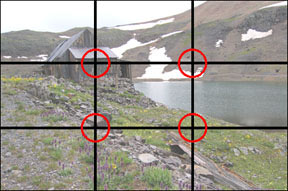
    composition2

    The Rule of Thirds has been used for centuries and is probably the most important of all the composition techniques. The Rule of Thirds means that the frame can be divided into three horizontal sections and three vertical sections and therefore, where the horizontal and vertical lines intersect makes an ideal location for the more important parts of your picture. By locating your main subject at one of the four intersections you give the subject more emphasis than if it was right smack in the middle of the picture. This is also a good technique if you have more than one important subject, the intersections can still work even if there’s a subject on more than one. The divisions can also be helpful in setting up a picture, they can for example, help you determine how much horizon you want. Most famous photographs or paintings in the world today have the rule of thirds applied to them in some way.

    Simplicity is the method of keeping the information in a photograph relatively simple. If your main subject is close, then your background should be very simple to avoid distractions. You should try to keep everything not important much less interesting than what’s important in the frame. Especially avoid lines or objects that lead the eye away from the subject.

    Framing is the tactic of using natural surroundings to add more meaning to your subject. It could be anything such as bushes, trees, a window, or even a doorway like in the picture at the top of this page. In the process of doing this you need to be careful that you don’t only focus on what’s framing your subject. Make sure you focus on the main subject, and also it is a good idea to use a narrow aperture (high f/stop) to achieve a high depth-of-field. It also wouldn’t hurt if the part of the picture framing the subject was darker so make sure you take your light reading on the main subject.

    Texture can add a significant amount of interest in any picture. When people see texture in pictures they start imagining what it feels like to touch what’s in the picture. Texture is a good idea when your taking pictures of rocks, walls, surfaces, someone’s hands, or leaves. In order to make a picture reveal a texture you must make sure the light is coming almost exactly from the side of the surface so it creates shadows in places key places.

    Leading Lines are used to lure the eye deeper into a picture or to an important subject. Straight, curved, parallel, or diagonal lines are all good at promoting interest. Good examples could be roads, rivers, streams, bridges, branches, or fences but there are endless things that could be used.

    Colors are what add heart and emotion to your pictures. Certain color configurations can inspire awe and amazement in onlookers. Colors can be used to add all sorts of accents and effects, but you must be careful to not draw attention away from the main subject.

    It might not be a bad idea to keep these key terms with you when you practice taking pictures. The best way to learn and improve your composition is just lots of practice and experimenting.

    Technique

    Top 10 Beginning Photography Tips


    1. Move in closer

    2. Be quick

    3. Compose with care

    4. Be selective

    5. Focus on your subject

    6. Experiment in time

    7. Look at the light

    8. Watch the weather

    9. Keep it simple

    10. Be Bold


    Cited from: http://wiki.answers.com/Q/What_are_all_of_the_different_kinds_of_photography ; http://en.wikipedia.org/wiki/Photography ; http://en.wikipedia.org/wiki/Camera#Focus ; http://digital-photography-school.com/shutter-speed ; http://www.great-landscape-photography.com/iso-speed.html ; http://www.ephotozine.com/article/Beginners-Guide-to-Photography--Metering-6351 ; http://digital-photography-school.com/introduction-to-white-balance ; http://www.picturecorrect.com/tips/photography-the-rules-of-composition/ ;
    http://www.betterphoto.com/exploring/tips.asp