Tuesday, October 12, 2010

Semester 2 - The Elderly Challenge

  1. What have you learnt?

- I learnt how to use Scamper and other thinking process methods such as Shape borrowing. I also learnt how to make joints on a prototype and make proper decisions when I need to do so. Not only that, I also improved on my organising skills as I had to organise my ADMT journal in a way that people can understand it properly. I also obtained better sketching and time management skills. We were running on a tight schedule and we had to manage our time properly so that we can complete our tasks on time.


  1. What are the difficulties encountered?

- There was a lack of time and it was difficult for us to make the prototype. For example, some properties of the product could not be implemented in the prototype to to resources/materials restraint.


  1. How did you overcome the difficulties?

I modified my prototype accordingly so that it can show the features of the original product with the materials I could get. I also learnt and tried to organise my time so that I could complete the tasks on time.


Link your reflection based on the 10 Cs.

  • Creativity

The making of the prototype and fully utilising the materials given to portray the unique features of my product.

  • Commitment

Sacrificing time and effort so as to complete the ADMT tasks on time.

Critical Thinking

- Using of Scamper and Shape borrowing to generate ideas.

Friday, September 24, 2010

Reflection - Prototype

1. What are the difficulties that you have encountered during the process?
We did not encounter much difficulties as the group was co-operative and everyone voiced out their opinions.
2. How do you overcome the difficulties encountered?
-NIL-
3. What are the 2 key takeaways for this lesson?
I learnt how to obtain evidence to prove that I have met my design criteria.
I also learnt that design criteria has to be as specific as possible.

Wednesday, July 21, 2010

Ergonomics(Product description and Idea Trigger)

(iv)

2)

(i)
The item is available in three colours- yellow, blue and green. It is translucent and oval. There are two rounded square holes in each product. It is flexible and is made out of plastic. There are two more cuts across the product, which will enable the socks to stay in place. You can use the product to hang your socks to dry them. This product is durable, compact and boasts a simple design. It is the harmonious marriage of the conventional clips and a little ingenuity.
(ii) Simplicity and user friendliness.
(iii)Yes. It is difficult to place the socks into the correct position. The elderly, whose hands are not as nimble as before, will have difficulty using the product. It is also not adjustable to fit the thickness of the socks. Besides that, you will need an external string to hang the socks onto a bamboo pole.

Wednesday, July 14, 2010

Ergonomics II

1. What is Ergonomics?
The science of designing the job, equipment, and workplace to fit the worker.

2. What are the 5 aspects of Ergonomics?
1)Safety
2)Comfort
3)Ease of use
4)Productivity/Performance
5)Aesthetics

3. For each aspects of Ergonomics, explain with an example of a product that is designed for the elderly, how the product meet that particular aspect of Ergonomics.

COMFORT
Dipesh Parmar p2-final.jpgVehicle for elderly
em for elderly to get in and out with comfort, minimum effort as well as walk inside bus easily. The components were decided considering the ergonomic principles of human comfort ability.
From user study point, the area which needs major improvement was ingress, egress and step height. Knee pain started during egress and wheelchair person also join a group, for which layout used is of maximum usability and comfortable support system for inside of bus.

http://www.idc.iitb.ac.in/projects/student/batch-07-09/dipesh.html

EASE OF USE
sit_squat.gif
Numerous studies by doctors have shown that squatting during passing motion is healthier and more ergonomic. However, some people, such as the elderly and the disabled, are unable to squat. This 2-in-1 sit-squat toilet caters to both needs.

http://www.pinz.com.sg/wc/home.html

SAFETY

steadystair-doe.php.jpg

When not in use, the handle goes from the square section to a round at either the top or bottom of the stairs and so the handle folds away parallel with the wall and is unobtrusive. This allows the stairs to be used by both those with unlimited and limited mobility in the household.
The benefit here is that older folks could still work their legs a bit. The downside? If you're at the top of the stairs and the SteadyStair is at the bottom, there's no way to recover it like a motorized chair. Amos and her team have a solution for that, though — two bars mounted to one rail.


http://dvice.com/archives/2009/11/steadystair-doe.php

AESTHETICS


2009_lp_calendar_L.jpg


Eyesight weakens with age. Hence, calendars should be resized to bigger ones specially for the elderly.

http://www.google.com.sg/imglanding?q=large%20print%20calendar&imgurl=http://eyedeashop.com/images/2009_lp_calendar_L.jpg&imgrefurl=http://eyedeashop.com/viewProduct.aspx%3Fid%3D1276%26category%3D0&usg=__UqLRtsaITkKGLSY1Q4J4SCkFNkU=&h=500&w=500&sz=172&hl=en&sig2=CSVPpkuhoaM7L6ZIp1Kbyg&itbs=1&tbnid=SKy4cEuSsDkKdM:&tbnh=130&tbnw=130&prev=/images%3Fq%3Dlarge%2Bprint%2Bcalendar%26hl%3Den%26gbv%3D2%26tbs%3Disch:1&ei=grs9TPSSJ8qHkAWIyfyjDA&gbv=2&tbs=isch:1&start=0#tbnid=SKy4cEuSsDkKdM&start=2

PRODUCTIVITY/PERFORMANCE

imagewrap.img.jpg

Freedom Dinnerware Scooper Plate with Suction Pad is deeper on one side to allow for easier scooping. Nearly unbreakable and dishwasher safe (top rack) FDA approved polypropylene.

Freedom Non Skid Dinnerware dishes were designed for people with hand tremors, paralysis, Parkinson's disease, arthritis, uncontrolled movement and disabilities that restrict hand movement necessary for eating independently. Extended rims, built in dividers, special scoop angles and the patented no slip suction pad base provide the solution to the problem.

Each one of the non skid Freedom Dinnerware scoop plates come with a no slip Freedom Suction Pad. Simply turn the Freedom Dinnerware scoop plate over and attach the Freedom No Slip Pad to the bottom of the non skid Freedom Dinnerware scoop plate, like putting a lid on a jar and turn it by hand until it is securely tight. Freedom Dinnerware scooper plates are ready for use.

The no slip Freedom Suction Pad is a patented vacuum system. When you place the non skid Freedom Dinnerware scooper plates with no slip pad attached, on a flat surface and push down with slight pressure , it creates a suction system that holds the Freedom scoop plates in place and will not move if you bump it or hit it. Perfect for flat table tops, wheelchair trays and over-bed tables. No more suction cup feet that slide and loose their grip.

http://www.arthritissupplies.com/site/371928/product/CFP161


Tuesday, July 13, 2010

Ergonomics-4

-Avoid stress or injury
-Care for welfare of customer
-Comfort
-Aesthetics
-Safety
-Ease of use
-Efficiency
-Relaxation

Ergonomics I

QUESTION 1


CHAIR

1)Chair’s height is hard to adjust

Difficult to bend

Chair is easily breakable and moves unpredictably by it’s own

2)Chair’s height is easy to adjust

Bends when it detects weight applied on it

Has an armrest extension and movable backrest


COMPUTER SCREEN/MONITOR

1)Computer screen cannot be adjusted/moved to allow the person to see easily

2)Monitor can be moved to suit the user’s needs


TABLE LIGHT

1)Light cannot be moved(lowered, change direction, etc.)

There is no place for the user to hold when they want to move it

2)Light can be adjusted to where the user needs it

A handle to enable the user to move the light without burning themselves


LAPTOP

1)Cannot move the laptop to cater to needs(No case)

2)Case lets the laptop tilt, move easily


DESK SPACE

1)Cluttered

No desk space

2)Clean desk

Items can be fixed on a rail above to make more space on the desk


QUESTION 2

No. 2 workplace is preferred.

1) The chair is more comfortable as it can move according to how much the user leans on it. However, in No.1 workplace, the chair is difficult to move and sometimes move drastically with every sight movement of the user. Besides that, the chair in No. 2 workplace has an external armrest that can be raised.

2)

Monday, June 21, 2010

Elderly Challenge - Observation 4

I found out that many signs in shopping malls are very small and not eye-catching. Hence, the elderly would have problems finding their way around.


From about age 40 onwards, some people would start to observe some form of decline in their sight. Although some seek the aid of spectacles, not all of them adjust to it well and prefer not to adapt to it. Hence, we have to take that into consideration so as to make the community a more elderly friendly place. The words on the signs should contrast with the background to create a 'flashing' look, and catch the eye of the elderly easily. Besides that, it should also be enlarged so that the elderly can read with greater ease.

Elderly Challenge - Observation 3

I found out that many senior citizens shun from group activities due to the misconception, and sometimes reality, of them being to strenuous.


Most elderly people would have retired and would have little to do at home. Some of them want to engage in a new activity to pass time but it is sometimes difficult to due to lack of strength and stamina or limited knowledge. With so much time and nothing to do, the person can find life boring and depressing. Hence, we should plan more activities specially catered for the elderly. These activities should not be too strenuous and the schedule for such events should not be so hectic. The activities should not involve vigorous physical involvement such as competitive swimming and should be carried out at a smooth and comfortable pace.


Saturday, June 19, 2010

SST_ADMT_ElderlyChallenge_S1-01_02_Khit Sue Lun.skp


-There are railings for the elderly to hold on while walking(for support).
-There are chairs around the room so that the elderly can sit down whenever she/he feels dizzy or unwell.
-There is a television for entertainment.
-The sofa is L-shaped so that the elderly will be able to lie down to watch the television programs. It might be more comfortable for them.
-The bed is low and the elderly would not have difficulties going on it.
-At times of need, the elderly can sit on the chair next to the wardrobe while choosing what clothes to wear or while cleaning up the wardrobe.
-All sharp edges will be padded to avoid injuries.

Holiday Homework - Part 1 Understanding the Elderly Challenge

Explain in your own words, the FOUR key recommendations of the report.

-Housing for seniors

Singapore will be fully catered for the elderly, introducing infrastructures to support them morally and live comfortably with the community and their family. There will be a wide variety of housing types that are suitable for the elderly so as to satisfy each and everyone needs and preferences. These would be inclusive of caring services to protect the elderly mentally and physically. Singapore should be the ideal place for the old and young.

-Accessibility for seniors

Singapore will be a haven for the elderly, one that allows them to connect and bond with the community and having more active lives. Homes and public places will be shaped for the use of the elderly. This will allow the elderly to move about safely, happily and conveniently throughout the island.

-Caring for seniors

The elderly in need of healthcare will be exposed to a variety of services specially designed for their needs. It will ensure the quality of life the elderly have. These services will be effective, priced sensibly and easily accessible to the elderly in the community.

-Opportunities for seniors

The elderly will be involved in the development of the community and will have close relationships with their closed ones. They should be healthy and living a happy and meaningful life. All Singaporeans should develop a good attitude towards the elderly and getting older.


State ONE way that the CAI report is recommending to make our public housing more elderly-friendly

-Under the Main Upgrading Project (MUP), the Housing Development Board (HDB) upgrades sold flats with elder-friendly features such as grab- bars in the bathroom / toilet and non-slip floor tiles.


State TWO ways on how we can ensure that the quality of elderly care here in Singapore is affordable

-The Government should top-up Medisave accounts of less well off Singaporeans when there are budgetary surpluses to ensure that seniors have the means to afford healthcare services.

-The Government should set up a Caregiver Centre to support families in care-giving through provision of information resources and programmes


After reading the CAI report, what do you are the THREE things that you can do, as an SST student, to help overcome these elderly challenges

-I can develop ideas for devices to help the elderly carry out daily activities in their lives with greater ease. Besides that, I can also generate ideas for activities they can participate in and plan them. This will help them to lead a healthier life. I can also come out with some ideas for the design of the elderly-friendly houses which will help them in terms of safety and convenience.

-I can visit the elderly at old folks’ homes to perhaps perform for them or talk and help them with their daily activities. This would provide moral support for them and conjure a smile on their faces.

-I can help to raise funds to support old folks’ homes so as to help them upgrade their facilities and provide a better environment for the elderly to live in.

Saturday, June 12, 2010

Elderly Challenge - Observation 2

As we grow older, changes take place in our heart vessels, which increase the risk of coronary heart disease and hypertension. The movement of the person is also slowed down. This causes a slight delay in response to stimulus.


Hence, an older person might take a longer time to complete daily activities, for example crossing the road. Action has been taken to deal with this problem. For example, some traffic lights are installed with a device, whereby the crossing time will be stretched when a senior citizen card is tapped on the device attached to it.


However, this can only be spotted in some places. I feel that this solution should be implemented throughout the island. The device should be attached to every traffic light to fight away the difficulties the elderly are facing.


Elderly Challenge - Observation 1


Osteoporosis, which is a form of severe bone degeneration, is common among elderly women. Arthritis is also a common problem. Even a small fall can result in complications such as hip fracture or paralysis. Some people are afraid to go out after such an experience. They have harboured a fear and do not want to take the risk of injuring themselves again. Hence, we will have to change public places, such as the void decks, shopping malls and parks, to more elderly-friendly ones.


The floors at the void deck is usually very slippery when it rains. This increases the risk of the elderly falling down, We should include devices that would ensure their safety, such as non-slip floors to prevent them from falling down. This would help them to go about with more confidence and at the same time, make sure that they are safe.


Tuesday, March 23, 2010

Personal Reflection (NEwater visit)

1. What are the 3 key takeaways from today’s visit?
1-I discovered the amazing technology behind NEwater.
2-I found out the urgent need to find more water taps for Singapore.
3-I learnt to appreciate water as I got to know that it is hard to get.
2. Name 2 concepts that you have learnt today during the visit.
1-Reverse osmosis can help to purify water.
2-Ulatrafliterlisation works by only letting water molecules to pass the selectively permeable membrane.
3. What is the 1 interesting thing that you have learnt today?
The existence of membrane technology.
4. What are the things that you can do to help with water conservation in Singapore?
I can contribute n small areas, such as ensuring that I do not leave the tap on while brushing my teeth. Though what I can do is constrained, I would still try my best.

Personal Reflection (NEwater visit)

1. What are the 3 key takeaways from today’s visit?
1-I discovered the amazing technology behind NEwater.
2-I found out the urgent need to find more water taps for Singapore.
3-I learnt to appreciate water as I got to know that it is hard to get.
2. Name 2 concepts that you have learnt today during the visit.
1-Reverse osmosis can help to purify water.
2-Ulatrafliterlisation works by only letting water molecules to pass the selectively permeable membrane.
3. What is the 1 interesting thing that you have learnt today?
The existence of membrane technology.
4. What are the things that you can do to help with water conservation in Singapore?
I can contribute n small areas, such as ensuring that I do not leave the tap on while brushing my teeth. Though what I can do is constrained, I would still try my best.

Tuesday, March 16, 2010

Personal Reflection (8th Mar 2010)

1. What are the 3 key takeaways from today’s lesson?
I discovered that we should have researched about things before planning. Next, I realised that we have to make things clearer for better understanding. The last takeaway is discovering new skills that would help in research work.
2. Name 2 concepts that you have learnt today pertaining to design and describe why is it important in design?
Authenticity and creativity. If an idea is not authentic, it would not spur that interest in the audience. Besides that, it is the creativity that makes a product stand out. A product that lacks creativity would not be interesting and would be looked as a "typical" product.
3. What is the 1 interesting thing that you have learnt today?
I learnt that every small detail can lead to a good or bad design.

Wednesday, February 17, 2010

Photographs

This is my bear,which I brought to school for show and tell. Sher Li likes it and tried to snatch it in the train.


Sorry the photo is upside down,but... This is Sher Li in the MRT. She was trying hard to dodge my "evil camera" and the photo was ruined.


Looking attentively at the phone...


Guang Jun is trying to get in the picture,a direct opposite of Sher Li. He probably wants his face to be posted on the blog!


This is Sher Li,who is trying to shun the camera again. Haha,she still can't get out of my "evil grasp"...

Friday, February 12, 2010

Photography

1)Types of Photography

Black-and-white

All photography was originally monochrome, or black and white.. Even after color film was readily available, black-and-white photography continued to dominate for decades, due to its lower cost and its "classic" photographic look. It is important to note that some monochromatic pictures are not always pure blacks and whites, but also contain other hues depending on the process. The cyanotype process produces an image of blue and white for example. The albumen process, first used more than 150 years ago, produces brown tones.

Colour Photography

Colour photography is photography that uses media capable of representing colors which are produced chemically during thephotographic processing phase. It is contrasted with black-and-white photography, which uses media capable only of showing shades of gray. It does not include hand colored or Photochrome photographs either. Some examples of color photography include prints, color negatives, transparencies and slides, and roll and sheet films.

Full Spectrum Photography

Full-spectrum photography is a subset of full-spectrum imaging, defined currently among photography enthusiasts as imaging with consumer cameras the full, broad spectrum of a film or camera sensor bandwidth.

Digital Photography

Digital photography is a form of photography that uses digital technology to make images of subjects. Until the advent of such technology, photography used photographic film to create images which could be made visible by photographic processing. By contrast, digital photographs can be displayed, printed, stored, manipulated, transmitted, and archived using digital and computer techniques, without chemical processing.

Other Forms...

  • Architectural photography
  • Candid photography
  • Cloudscape photography
  • Documentary photography
  • Fashion photography
  • Fine art photography
  • Fire photography
  • Forensic photography
  • Food photography
  • Glamour photography
  • Head shot
  • Landscape art
  • Miksang (contemplative photography)
  • Nature photography
  • Photojournalism
  • Portrait photography
  • Sports photography
  • Still life photography
  • Stock photography
  • Street photography
  • Travel photography
  • Underwater photography
  • Vernacular photography
  • VR photography
  • War photography
  • Wedding photography
  • Wildlife photography

Equipment


Aperture
The aperture stop of a photographic lens can be adjusted to control the amount of light reaching the film or image sensor. In combination with variation of shutter speed, the aperture size will regulate the film's degree of exposure to light. Typically, a fast shutter speed will require a larger aperture to ensure sufficient light exposure, and a slow shutter speed will require a smaller aperture to avoid excessive exposure.

Focus


Rangefinder cameras allow the distance to objects to be measured by means of a coupled parallax unit on top of the camera, allowing the focus to be set with accuracy. Single-lens reflex cameras allow the photographer to determine the focus and composition visually using the objective lens and a moving mirror to project the image onto a ground glass or plastic micro-prism screen. Twin-lens reflex cameras use an objective lens and a focusing lens unit (usually identical to the objective lens.) in a parallel body for composition and focusing. View cameras use a ground glass screen which is removed and replaced by either a photographic plate or a reusable holder containing sheet film before exposure. Modern cameras often offer autofocus systems to focus the camera automatically by a variety of methods.
Shutter Speed

Shutter speed is ‘the amount of time that the shutter is open.

In film photography it was the length of time that the film was exposed to the scene you’re photographing and similarly in digital photography shutter speed is the length of time that your image sensor ’sees’ the scene you’re attempting to capture.

  • Shutter speed is measured in seconds – or in most cases fractions of seconds. The bigger the denominator the faster the speed (ie 1/1000 is much faster than 1/30).
  • In most cases you’ll probably be using shutter speeds of 1/60th of a second or faster. This is because anything slower than this is very difficult to use without getting camera shake. Camera shake is when your camera is moving while the shutter is open and results in blur in your photos.
  • If you’re using a slow shutter speed (anything slower than 1/60) you will need to either use a tripod or some some type of image stabilization (more and more cameras are coming with this built in).
  • Shutter speeds available to you on your camera will usually double (approximately) with each setting. As a result you’ll usually have the options for the following shutter speeds – 1/500, 1/250, 1/125, 1/60, 1/30, 1/15, 1/8 etc. This ‘doubling’ is handy to keep in mind as aperture settings also double the amount of light that is let in – as a result increasing shutter speed by one stop and decreasing aperture by one stop should give you similar exposure levels (but we’ll talk more about this in a future post).
  • Some cameras also give you the option for very slow shutter speeds that are not fractions of seconds but are measured in seconds (for example 1 second, 10 seconds, 30 seconds etc). These are used in very low light situations, when you’re going after special effects and/or when you’re trying to capture a lot of movement in a shot). Some cameras also give you the option to shoot in ‘B’ (or ‘Bulb’) mode. Bulb mode lets you keep the shutter open for as long as you hold it down.
  • When considering what shutter speed to use in an image you should always ask yourself whether anything in your scene is moving and how you’d like to capture that movement. If there is movement in your scene you have the choice of either freezing the movement (so it looks still) or letting the moving object intentionally blur (giving it a sense of movement).
  • To freeze movement in an image (like in the surfing shot above) you’ll want to choose a faster shutter speed and to let the movement blur you’ll want to choose a slower shutter speed. The actual speeds you should choose will vary depending upon the speed of the subject in your shot and how much you want it to be blurred.

  • Motion is not always bad – I spoke to one digital camera owner last week who told me that he always used fast shutter speeds and couldn’t understand why anyone would want motion in their images. There are times when motion is good. For example when you’re taking a photo of a waterfall and want to show how fast the water is flowing, or when you’re taking a shot of a racing car and want to give it a feeling of speed, or when you’re taking a shot of a star scape and want to show how the stars move over a longer period of time etc. In all of these instances choosing a longer shutter speed will be the way to go. However in all of these cases you need to use a tripod or you’ll run the risk of ruining the shots by adding camera movement (a different type of blur than motion blur).
  • Focal Length and Shutter Speed - another thing to consider when choosing shutter speed is the focal length of the lens you’re using. Longer focal lengths will accentuate the amount of camera shake you have and so you’ll need to choose a faster shutter speed (unless you have image stabilization in your lens or camera). The ‘rule’ of thumb to use with focal length in non image stabilized situations) is to choose a shutter speed with a denominator that is larger than the focal length of the lens. For example if you have a lens that is 50mm 1/60th is probably ok but if you have a 200mm lens you’ll probably want to shoot at around 1/250
  • ISO Speed

    ISO in ISO Speeds stands for International Standards Organisation on and a few decades ago they came up with a standard for measuring the speed of film called the ISO Speed.

    As with aperture and shutter speed, film speeds are goverened by a factor of two rule. There have been some films that broke that rule along the way but, in general, those were new films that were pushing the boundaries in speed.

    Film speeds come in the following ratings:

    25, 50, 100, 200, 400, 800, 1600 and 3200

    The speed of a film is the measure of how fast it responds to light. A low ISO speed means a film responds slowly to light, a fast ISO speed means the film responds quickly. Those silver squares you see on the film casing tell the camera what the film's ISO speed is (for cameras that can read them).

    Metering
    Metering is a process which involves the camera taking a light level reading from the scene and selecting the appropriate combination of aperture and shutter speed to set the required exposure value. Various modes are offered to allow the user to select the most suitable one for the specific lighting conditions These can then be changed manually via use of exposure compensation metre if required. There are various types of metering which can be set, and these change the way the light levels are read by the camera.

    White Balance

    White Balance is an aspect of photography that many digital camera owners don’t understand or use – but it’s something well worth learning about as it can have a real impact upon the shots you take.

    At its simplest – the reason we adjust white balance is to get the colors in your images as accurate as possible.


    Composition


    Composition is the combining of distinct parts or elements to form a whole. In photography that thought is very important in taking good pictures. The following guidelines are just to be thought about though, it is not necessary to try to use them with every picture you take or there wouldn’t be any creativity in your work. Once you learn these rules and strategies you will be more prepared to find great picture spots and opportunities.

    Before you just step up and take a picture you should consider what you want your viewers to look at and how you should display main points of interest. You should ask yourself, what is the main subject? What angle should the light be hitting in my picture? Is there anything that could accentuate the main subject? Where should the main subject be in the frame? These are all important things you should consider, but that doesn’t necessarily mean you need to follow the rules exactly.

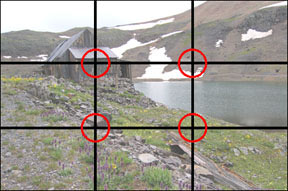
    composition2

    The Rule of Thirds has been used for centuries and is probably the most important of all the composition techniques. The Rule of Thirds means that the frame can be divided into three horizontal sections and three vertical sections and therefore, where the horizontal and vertical lines intersect makes an ideal location for the more important parts of your picture. By locating your main subject at one of the four intersections you give the subject more emphasis than if it was right smack in the middle of the picture. This is also a good technique if you have more than one important subject, the intersections can still work even if there’s a subject on more than one. The divisions can also be helpful in setting up a picture, they can for example, help you determine how much horizon you want. Most famous photographs or paintings in the world today have the rule of thirds applied to them in some way.

    Simplicity is the method of keeping the information in a photograph relatively simple. If your main subject is close, then your background should be very simple to avoid distractions. You should try to keep everything not important much less interesting than what’s important in the frame. Especially avoid lines or objects that lead the eye away from the subject.

    Framing is the tactic of using natural surroundings to add more meaning to your subject. It could be anything such as bushes, trees, a window, or even a doorway like in the picture at the top of this page. In the process of doing this you need to be careful that you don’t only focus on what’s framing your subject. Make sure you focus on the main subject, and also it is a good idea to use a narrow aperture (high f/stop) to achieve a high depth-of-field. It also wouldn’t hurt if the part of the picture framing the subject was darker so make sure you take your light reading on the main subject.

    Texture can add a significant amount of interest in any picture. When people see texture in pictures they start imagining what it feels like to touch what’s in the picture. Texture is a good idea when your taking pictures of rocks, walls, surfaces, someone’s hands, or leaves. In order to make a picture reveal a texture you must make sure the light is coming almost exactly from the side of the surface so it creates shadows in places key places.

    Leading Lines are used to lure the eye deeper into a picture or to an important subject. Straight, curved, parallel, or diagonal lines are all good at promoting interest. Good examples could be roads, rivers, streams, bridges, branches, or fences but there are endless things that could be used.

    Colors are what add heart and emotion to your pictures. Certain color configurations can inspire awe and amazement in onlookers. Colors can be used to add all sorts of accents and effects, but you must be careful to not draw attention away from the main subject.

    It might not be a bad idea to keep these key terms with you when you practice taking pictures. The best way to learn and improve your composition is just lots of practice and experimenting.

    Technique

    Top 10 Beginning Photography Tips


    1. Move in closer

    2. Be quick

    3. Compose with care

    4. Be selective

    5. Focus on your subject

    6. Experiment in time

    7. Look at the light

    8. Watch the weather

    9. Keep it simple

    10. Be Bold


    Cited from: http://wiki.answers.com/Q/What_are_all_of_the_different_kinds_of_photography ; http://en.wikipedia.org/wiki/Photography ; http://en.wikipedia.org/wiki/Camera#Focus ; http://digital-photography-school.com/shutter-speed ; http://www.great-landscape-photography.com/iso-speed.html ; http://www.ephotozine.com/article/Beginners-Guide-to-Photography--Metering-6351 ; http://digital-photography-school.com/introduction-to-white-balance ; http://www.picturecorrect.com/tips/photography-the-rules-of-composition/ ;
    http://www.betterphoto.com/exploring/tips.asp